Building a home podcast studio feels like the obvious first move — no hourly rate, no scheduling around someone else’s availability, full control of the space. But the real comparison is more nuanced than “free vs. paid,” and the wrong choice can quietly cost more than the right one.
The True Cost of a Home Setup
A basic home setup — decent USB mic, ring light, webcam — runs $300–$600 and gets you recording. But “recording” and “sounding professional” are different bars. Real acoustic treatment (panels, bass traps, a properly isolated space), a multi-camera setup, and lighting that doesn’t look like a ring light all push a genuinely production-ready home studio into the $3,000–$8,000+ range once you account for the room build-out itself — money spent on equipment that depreciates and a room that can’t be used for much else.
The Time Cost Nobody Budgets For
Every session in a home studio starts with setup: lights, camera angles, audio levels, checking for background noise you didn’t notice before. Multiply that across every recording, every week, and it adds up to hours of unpaid production labor that a studio session eliminates entirely — you show up, sit down, and start talking.
Where Renting a Professional Studio Wins
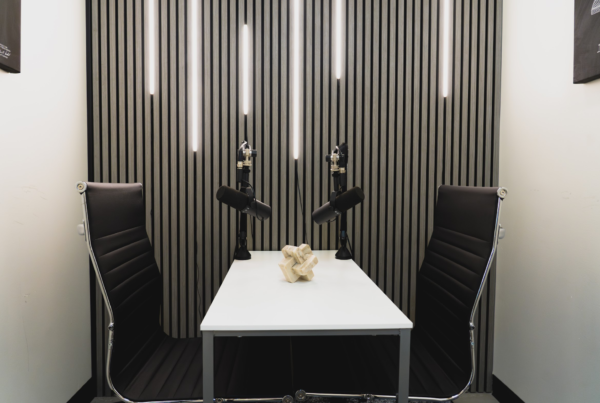
A studio session bundles the equipment cost, the acoustic treatment, the lighting design, and an engineer’s time into a single hourly rate — typically $200–$300/hr for a fully-produced session in a market like Chicago. For a show recording once or twice a month, that’s dramatically cheaper than the capital outlay of building an equivalent home setup, and the quality ceiling is higher than most home builds will ever reach.
Where a Home Studio Wins
If you’re recording daily, or your format doesn’t require video (a solo, audio-only show, for instance), the math flips — the per-session cost of renting adds up faster than a modest home investment amortizes. A home studio also removes any scheduling dependency, which matters for shows that need to record reactively to news or timely topics.
The Middle Path Most Successful Podcasters Actually Use
Many established shows use both: a home setup for quick, lower-stakes recording between “real” sessions, and a professional studio for flagship episodes, guest interviews, or monthly batching days where production quality needs to be at its best. This gets you flexibility without asking a bedroom corner to do a studio’s job every single time.
How to Decide
If you’re launching and unsure of your format or cadence yet, start with studio sessions — the cost is variable and scales with actual usage, versus committing capital to a home build before you know what your show needs. You can always build a home setup later once your format and release rhythm are proven.
Not sure which fits your show? Compare our studio sets and pricing before deciding.